

TL;DR: ADHD treatment in adults typically combines medication, therapy, and practical strategies, but there is no single right path. This guide breaks down every real option available in the UK, what each one costs you (in time, money, and effort), and how to figure out which combination makes sense for your brain and your life.

You Are Not Looking for a Textbook. Neither Am I.
Something brought you here. Maybe it was a conversation you did not handle well. Maybe it was another Monday where you meant to get everything done and got nothing done. Maybe it was a diagnosis that arrived three weeks ago and you have been sitting with it ever since, not quite sure what to do next.
The NHS page tells you that treatment “typically involves medication and therapy.” The Mayo Clinic lists the options in bullet points. Neither of them tells you what it actually feels like to navigate this, or which door to knock on first, or what to do when the first thing you try does not work.
This is that guide.
What Is Actually Going On in an ADHD Brain
Before you can pick a treatment, it helps to understand what you are treating. Not to lecture you, but because this changes which options will make sense for you.
ADHD is a difference in how dopamine and noradrenaline are regulated in the brain, not a character flaw or a failure of effort. The prefrontal cortex, the part responsible for planning, impulse control, and sustained attention, is less consistently active in ADHD brains. This is not a theory. It is visible in brain imaging studies NIMH overview of ADHD neuroscience
What this means in practice: you are not lazy. Your brain is running a different operating system, one that struggles to maintain activation for tasks that do not provide immediate interest, urgency, or emotional weight. Understanding this matters because it tells you why willpower alone has never worked and never will.
What causes ADHD is largely genetic. If you have it, someone in your family almost certainly does too, even if they were never diagnosed. Environmental factors can influence how it presents, but the underlying neurology is mostly inherited.
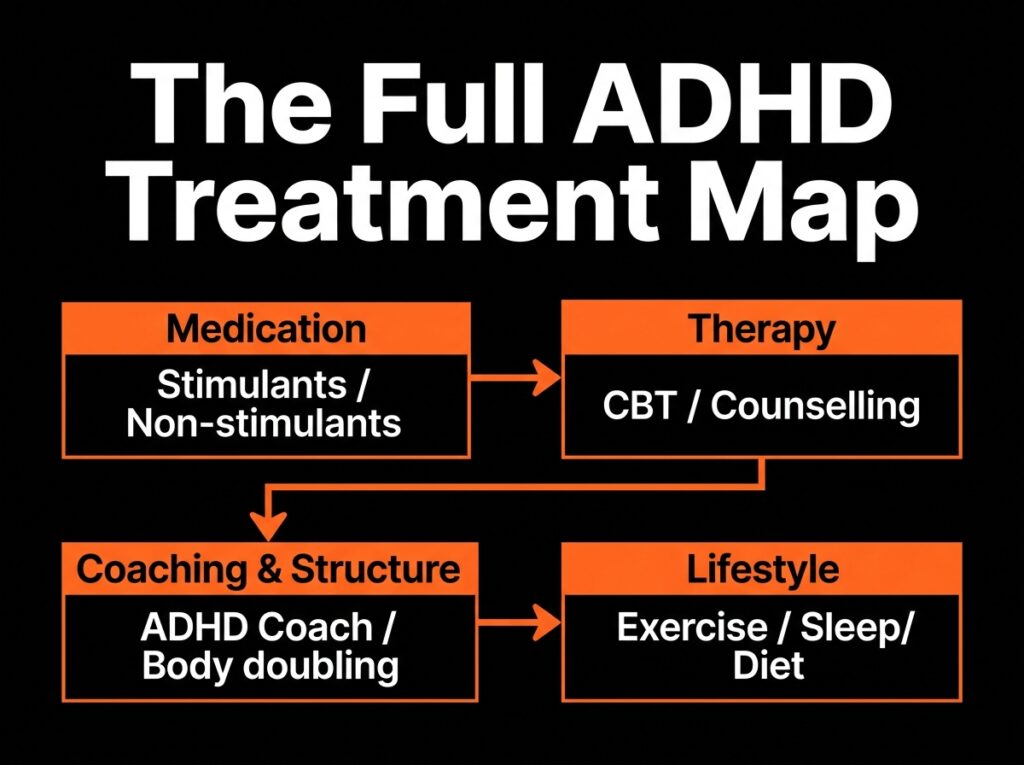
The Full Map: Every ADHD Treatment Option
1. ADHD Medications for Adults
Medication is the most effective single intervention for ADHD across the research. That is not an opinion, it is the consistent finding across decades of clinical data. But it is not the only intervention and it does not work for everyone.
There are two main categories of ADHD medication in the UK:
| Type | Examples | How They Work | Who They Suit |
| Stimulants | Methylphenidate (Ritalin, Concerta), Lisdexamfetamine (Vyvanse) | Increase dopamine and noradrenaline availability | Most adults, first-line treatment |
| Non-stimulants | Atomoxetine (Strattera), Guanfacine | Different mechanism, slower build-up | Those who cannot tolerate stimulants, or need 24-hour coverage |
Stimulants are not addictive in the way people fear when taken as prescribed. The concern about addiction typically relates to misuse. Prescribed doses work differently from recreational use.
Side effects are real and vary by person. Reduced appetite, disrupted sleep, and a flattened emotional range are the most commonly reported. These are manageable for most people with dose adjustment. For some, they are not acceptable, and that is legitimate.
If medication is not working, it is worth knowing this: the first medication tried is not always the right one. Many people need to try more than one type or adjust the dose before finding what works. If your experience with ADHD medication has been bad, that does not mean medication cannot help you.
2. Getting ADHD Medication in the UK
This is where the path gets frustrating, and you deserve honesty about it.
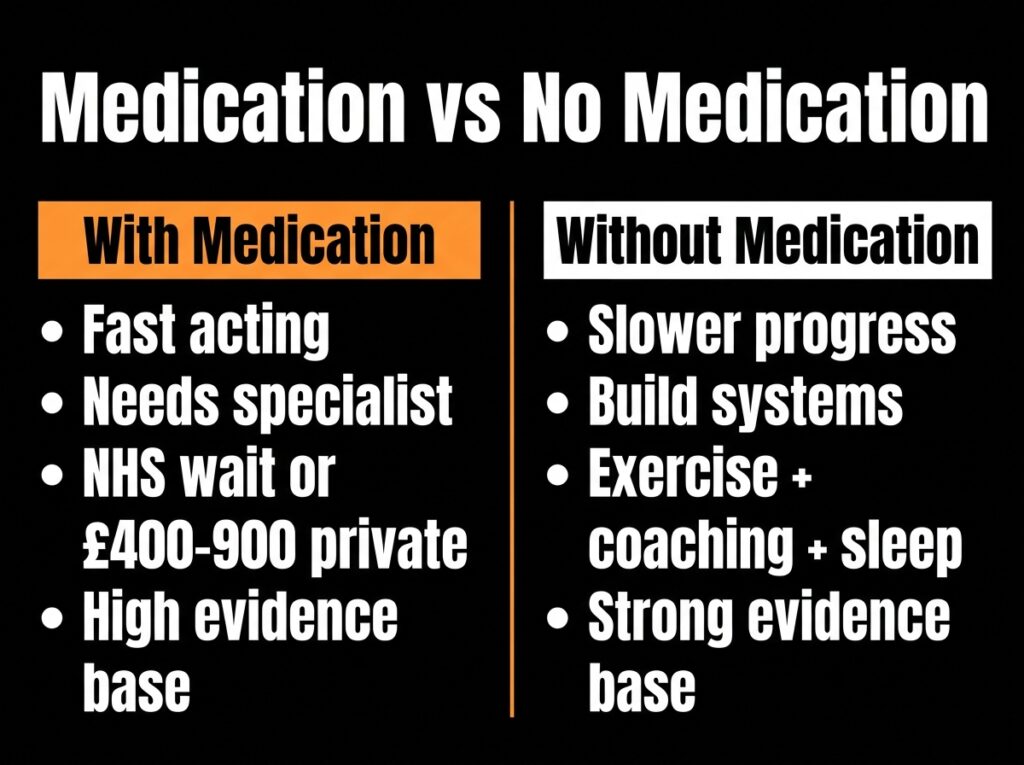
The NHS route involves a GP referral to a psychiatrist or specialist ADHD service. In many areas, the waiting list is currently two to three years. This is not a small inconvenience. It is a genuine barrier.
Your options for ADHD medication UK adults:
- NHS referral: Slow, but free once you get there. Ask your GP for a referral and get on the list now, even if you plan to go private in the meantime.
- Right to Choose: Under NHS England rules, you can request a referral to an NHS-funded private ADHD specialist, bypassing the local waiting list. This applies in England. Ask your GP specifically for this.
- Private assessment: Typically costs between £400 and £900 for the assessment, then ongoing prescription costs. Once diagnosed and stable, many private providers can arrange a Shared Care Agreement with your GP so the NHS continues the prescription.
- ADHD specialists online: Services like Psychiatry UK and ADHD 360 offer online assessments under Right to Choose or privately. They are legitimate and regulated. They are not a shortcut to medication they should not prescribe, they are a faster route to proper clinical care.
3. Therapy and Psychological Support
Medication addresses the neurological baseline. It does not automatically fix the habits, beliefs, and patterns that twenty or thirty years of unmanaged ADHD has built up.
Cognitive Behavioural Therapy (CBT) adapted for ADHD is the most evidence-backed psychological treatment. It focuses on practical skills: time management, breaking tasks down, managing emotional reactivity, and dismantling the self-blame stories that accumulate over a lifetime of “why can’t I just be normal.”
It is different from standard CBT. Standard CBT works well for anxiety and depression. ADHD-adapted CBT has to account for the fact that insight alone rarely changes behaviour when the executive function system is the thing that is struggling.
You should know that finding a therapist who actually specialises in adult ADHD is harder than it should be. Many therapists have surface-level knowledge. Ask specifically whether they have experience treating adults with ADHD before committing to a course of sessions.
4. How to Manage ADHD Without Medication: What Actually Works

If you are not going down the medication route, or not yet, this is not the consolation prize section. Non-medication strategies are real interventions. They require more active effort than a prescription, but they work.
The ones with actual evidence behind them:
Body-based regulation:
- Consistent vigorous exercise is the most consistently effective non-medication intervention. 30 minutes of cardio increases dopamine and noradrenaline availability, mimicking some of what stimulant medication does. This is not motivational fluff, it is replicated in research.
- Sleep is not optional. ADHD and disrupted sleep create a feedback loop. Protecting sleep consistently is one of the highest-leverage changes you can make.
Environmental design:
- Remove friction from the tasks you need to do. Add friction to the things that pull you off course. Your environment does the executive function work that your brain struggles with.
- External structure (body doubling, coworking, accountability partners) works because ADHD brains activate more reliably with social cues than internal ones.
ADHD coaching:
- Different from therapy. A good ADHD coach works on practical systems, accountability, and implementation rather than emotional processing. This is the option that fills the gap between understanding your ADHD and actually living differently with it.
- Look for coaches accredited through the International Coaching Federation with specific ADHD training.
Nutrition and supplements:
- The evidence for a full ADHD management programme here is thinner, but omega-3s and certain micronutrients play a supporting role in dopamine synthesis and general brain function. These are additions to a broader approach, not replacements for it.
5. ADHD Management as a Long Game
The honest answer about ADHD management for adults is that it is not a problem you solve once.
It is a set of conditions you maintain. Medication needs reviewing as life changes. Strategies that worked in one job or one life phase stop working in another. Burnout, hormonal shifts, high-stress periods, all of these can change how your ADHD presents and what it needs.
The people who manage ADHD well over the long term are the ones who treat it as an ongoing relationship with their own brain, not a one-time fix. They adjust, experiment, and stay honest with themselves about what is and is not working.
This is not pessimistic. It is realistic in a way that actually prepares you to succeed.
A Simple Starting Framework
If you are not sure where to begin:
- Get on the NHS list now. Contact your GP this week for a referral. The wait is long. The best time to start it was last year. The second best is today.
- Request Right to Choose. In England, ask your GP to refer you to an NHS-funded private ADHD service. This moves faster.
- Start the exercise habit before anything else. It is free, it works, and it makes every other intervention more effective.
- Design your environment before trying to improve your willpower. Systems beat intentions every time.
- Find one person who gets it. A coach, a therapist, a community. ADHD is harder to manage in isolation.
Frequently Asked Questions
Is ADHD medication addictive?
When taken as prescribed and at therapeutic doses, stimulant ADHD medication carries a low addiction risk. The concern about addiction mostly relates to misuse. For the majority of people, prescribed medication does not create dependence.
How do I actually get ADHD treatment on the NHS without waiting two years?
Ask your GP for a Right to Choose referral to an NHS-funded private ADHD service. This applies in England and bypasses the local waiting list. It is an NHS-funded route that most GPs do not mention unless you ask.
Why is my ADHD medication not working?
Several reasons are possible: the dose may be wrong, the specific medication may not suit you, timing matters a lot, or untreated sleep issues may be cancelling out the effect. Go back to your prescribing clinician and be specific about what is and is not happening. The first prescription is rarely the final one.
Can adults actually manage ADHD without medication?
Yes, though it requires more active construction of your environment, habits, and support. Exercise, structured coaching, environmental design, and sleep management are all evidence-backed. Many adults use a combination of medication and non-medication strategies for the best result.
What is the difference between an ADHD coach and an ADHD therapist?
A therapist processes the emotional and psychological impact of ADHD, including the accumulated shame, anxiety, and self-belief issues. A coach focuses on practical implementation, systems, and accountability. Both are useful. They are not interchangeable.
If one thing from this article is worth doing today, it is starting the referral conversation with your GP. The wait for ADHD treatment in the UK is genuinely long, and the earlier that clock starts, the better. While you wait, build the exercise habit and read up on environmental design strategies. By the time your assessment comes through, you will already have changed more than you think.
