
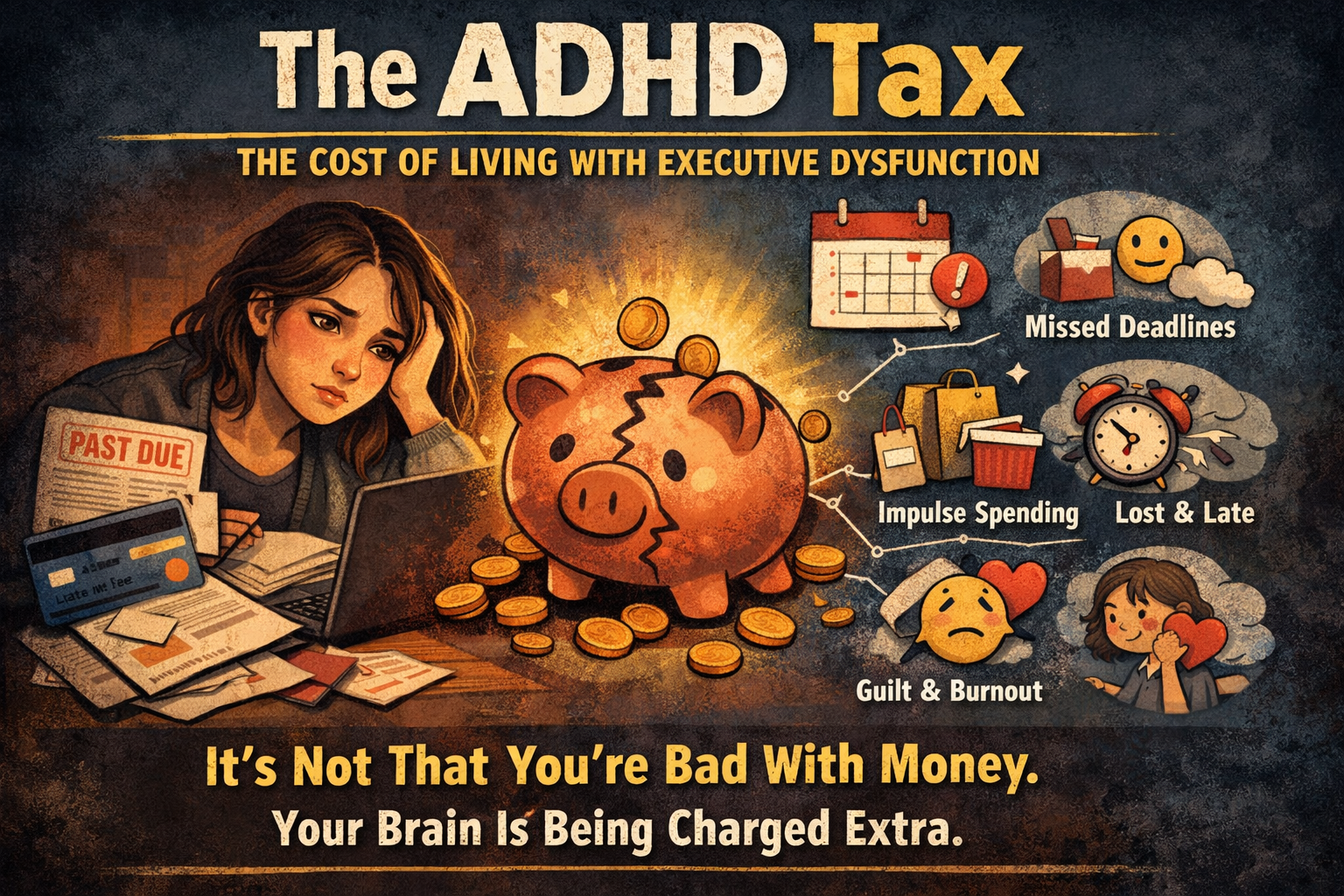
TL;DR: The ADHD tax is the extra money, time, and energy that people with ADHD spend because of executive dysfunction, not carelessness. It covers everything from forgotten subscriptions and late fees to the emotional cost of a life spent apologising for things you couldn’t control. If you just found this term and felt something shift, you’re in the right place.

The Night the Term Finally Landed
It was a Tuesday. Around half eleven. She was doing that thing where you scroll Reddit instead of sleeping, and she stumbled onto a thread in r/ADHD.
Someone had posted a list. The Tesco meal deal they bought three days running because they couldn’t think ahead to make lunch. The gym membership running for eight months after they stopped going. The parking fine they found in a drawer, now doubled because they’d missed the appeal window. The Deliveroo order because they’d stood in front of the fridge for twenty minutes and still couldn’t start cooking.
At the bottom of the post, the person had written: “ADHD tax is brutal this month.”
She read it twice.
Then she sat there for a while.
Not because it was sad, exactly. Because it had a name. All of it, the chaos she’d been paying for and apologising for and feeling ashamed of her entire adult life, had a name that wasn’t “lazy” or “irresponsible” or “you really need to get it together.”
If that moment sounds familiar, this is for you.
What the ADHD Tax Actually Is
The ADHD tax is not one thing. It’s the accumulation.
It’s every cost, financial, social, professional, and emotional, that you pay because a neurotypical world is built for brains that function differently to yours. It’s the surcharge on being you, applied daily, often invisibly, and almost never acknowledged.
The money part gets talked about most, but it’s only one layer.
Here’s a rough breakdown of where it shows up:
| Category | ADHD Tax Examples |
| Financial | Late payment fees, duplicate subscriptions, impulse buys, wasted food, last-minute travel |
| Time | Searching for lost items, redoing tasks, being late, recovery time after overwhelm |
| Professional | Missed deadlines, lost contracts, jobs that went badly, interviews that went worse |
| Social | Cancelled plans, forgotten birthdays, relationships worn down by misread signals |
| Emotional | Shame spirals, the mental load of managing systems that don’t stick, the exhaustion of masking |
| Health | Missed appointments, forgotten medications, skipped meals replaced with whatever’s easiest |
The ADHD tax in the UK looks particularly punishing because so many of the systems here, benefits, council tax, NHS referrals, direct debits, require sustained admin that actively demands the executive function ADHD impairs. The gap between knowing you need to do something and actually doing it isn’t a character flaw. It’s a neurological one.
what executive dysfunction actually feels like day to day
Why Budgeting Apps Don’t Fix This
Here’s the thing about ADHD tax advice you’ll find most places. It usually goes: make a spreadsheet, set reminders, automate everything, use a bullet journal.
And look. Automation helps. We’ll get to that.
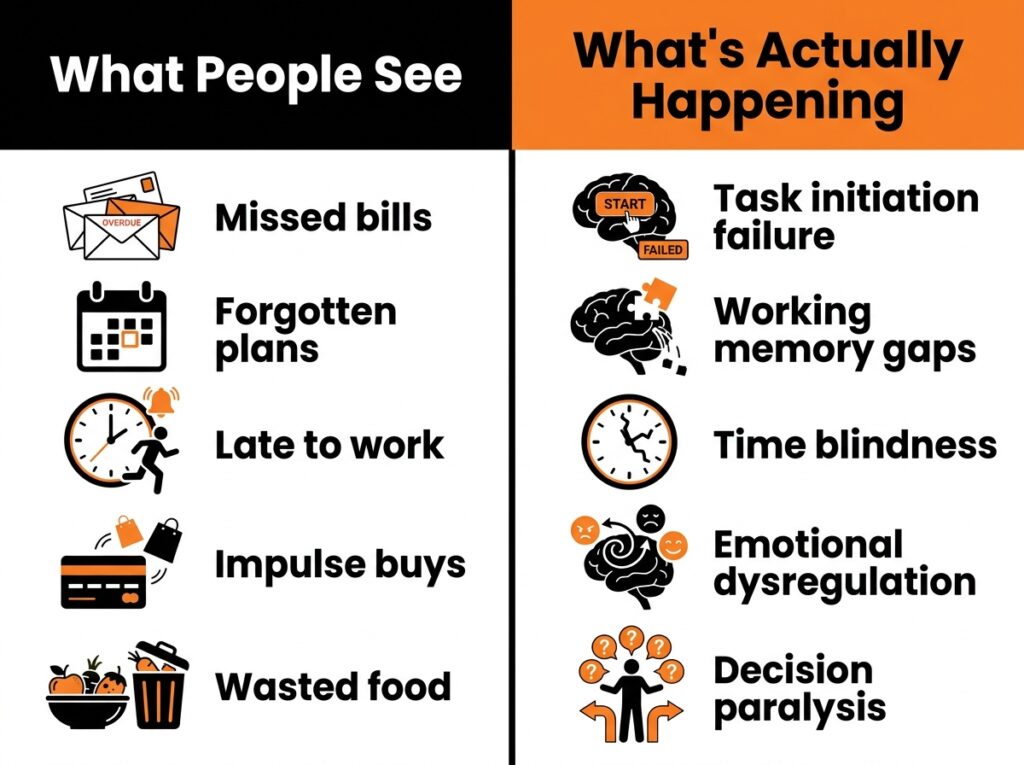
But most of the advice misses the actual problem, which is not that people with ADHD don’t know what they should do. They know. The ADHD tax exists because the gap between knowing and doing is where executive dysfunction lives.
You can set a reminder for 6pm to start cooking dinner. The reminder goes off. You dismiss it. You intend to do it. You get absorbed in something else. At 8pm you’re hungry and exhausted and you order pizza and feel terrible about it.
That’s not a reminder failure. That’s task initiation failure. Reminders help neurotypical people who forgot. They don’t always help ADHD brains that are stuck.
This is why the ADHD tax meme resonates so hard in communities like r/ADHD. It’s not funny because it’s relatable in a quirky way. It’s funny because laughing at it together is the only sane response to something genuinely unfair. The meme is grief wearing a punchline.
The Autism Tax Is Real Too
A quick mention for anyone who searched “autism tax” and ended up here.
The same principle applies. Autistic people pay a different but equally real version, sensory-safe food that costs more, transport because the standard commute is overwhelming, therapy that insurance or the NHS won’t fully cover, adjustments that come out of pocket because getting them formally recognised is its own exhausting process.
The specific costs differ. The structural cause is the same: the world charges extra for brains that aren’t standard-issue.
neurodivergent burnout and why it keeps coming back

What Actually Helps (Without Pretending It’s Simple)
Let’s be honest about what “solutions” can and can’t do here. The ADHD tax isn’t a problem you solve once. It’s something you manage, imperfectly, with systems that need to work with your brain rather than demanding your brain work like someone else’s.
Some things that actually move the needle:
Reduce decisions, don’t add them. Every system that requires you to remember to use it will eventually fail. Automation isn’t a productivity hack, it’s removing the gap where executive dysfunction operates. Direct debits for bills. Auto-renew for prescriptions. Standing orders instead of manual transfers.
Lower the activation energy for the right choices. Meal kits aren’t laziness, they’re decision-offloading. Having the same breakfast every day isn’t boring, it’s one less place the tax can hit. Working with how your brain actually initiates tasks, with external deadlines, body doubling, or novelty, will always beat white-knuckling through systems designed for different brains.
Stop treating every failure as a character flaw to fix. The shame spiral is itself an ADHD tax. The hours spent feeling terrible about the thing you didn’t do are hours you’re not spending on anything useful. You’re not bad at life. You are navigating life on a harder difficulty setting without a manual.
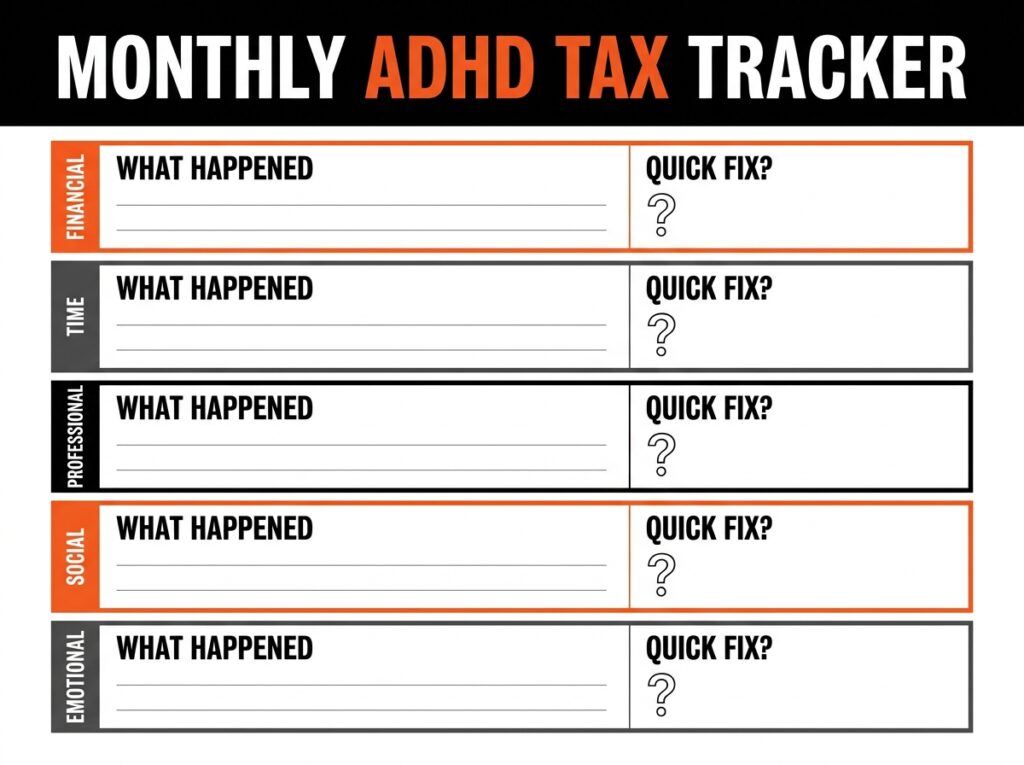
Track the tax deliberately for one month. Not to punish yourself. To get accurate data. Most people with ADHD underestimate what they’re losing because shame makes us not look directly at it. Looking at it clearly is the first step to deciding which bits to tackle first.
Here’s a simple framework for that:
| Tax Category | What to track | Likely quick win? |
| Subscriptions | Monthly statements, check for unused | Yes, cancel or pause |
| Late fees | Bank and council tax statements | Yes, switch to direct debit |
| Wasted food | Weekly food shop vs food binned | Medium, lower shop variety first |
| Impulse spending | Card transactions, note triggers | Medium, longer work |
| Time lost to chaos | Rough daily log for two weeks | No, but reveals patterns |
You’re Not the Problem. You’re Just Paying for It.
The ADHD tax is real, it compounds, and it is not your fault.
That last sentence matters. It’s not that nothing is your responsibility. It’s that responsibility looks different when the tools everyone else is using don’t work for your brain. You have been doing your best inside a system that was never designed for you. The fact that your best has cost you more than it should isn’t a moral failing. It’s a design flaw.
The term exists because communities of ADHD people named a collective experience and refused to be individually ashamed of something structural. That’s worth holding onto.
Frequently Asked Questions
What is the ADHD tax in simple terms?
The ADHD tax refers to all the extra money, time, and energy people with ADHD spend because executive dysfunction makes everyday admin and organisation harder. It includes things like late fees, forgotten subscriptions, lost items, and impulse spending, but also emotional and professional costs that rarely get counted.
Is the ADHD tax a real thing or just a meme?
Both, and that’s sort of the point. The meme format spread the term fast because it put a name to something millions of people were living with silently. The underlying reality is documented: research consistently shows ADHD is associated with higher rates of financial difficulty, job loss, and chronic stress. The meme made it shareable. The reality made it stick.
What are common ADHD tax examples in the UK?
In the UK, common examples include council tax late payment surcharges, TV licence penalties, missed NHS appointments (which can result in discharge from waiting lists), duplicate streaming subscriptions, Ubers taken because planning ahead felt impossible, food waste, and the financial cost of impulsive online shopping during hyperfocus or low-mood spirals.
Does the autism tax work the same way?
The autism tax follows the same logic: the extra costs, financial and otherwise, that autistic people bear because the world isn’t built for sensory, social, or processing differences. The specific costs differ (sensory-safe products, additional transport needs, private therapy) but the structural unfairness is the same.
How do I actually start reducing my ADHD tax?
Start with automation over willpower. Direct debits for every regular bill. Subscription audits twice a year. Then work on reducing decision points rather than adding discipline. Track your specific tax for one month without judgement before deciding what to tackle. The goal isn’t perfection. It’s removing the most expensive gaps between knowing and doing.
Ready to go deeper? If the ADHD tax is hitting you hardest in the focus and productivity department, it’s worth understanding how your brain’s dopamine system actually drives the knowing-doing gap, not just the money stuff. why ADHD brains struggle to start tasks and what to do about it
